Scottish Gaelic working paper
Gaelic recordings on the Island Voices YouTube channel provide the empirical data to inform the Leacan 2 corpus planning project on how the language is spoken in real life. The project is led by Glasgow University for Bòrd na Gàidhlig, with support from the UHI Language Sciences Institute, among others. With the UHI contribution now complete, an edited version of the paper offering applied and sociolinguistic commentary “with a view to identification of features of traditional Gaelic requiring description and guidance” is now made available in the online open access “Working Papers in Urban Language & Literacies” series.
It’s a very interesting series, described in some detail in Working papers for a more open academy, with a mission to develop “sociolinguistic, applied and educational frameworks adequate for the analysis of urban language, literacies, interaction and learning; [as well as] modes of intervention in language policy and practice that are productively tuned to the realities of contemporary urban life”, noting also that ‘urban’ has been dropped from the latest iterations of this statement. That’s a philosophy that fits well with Island Voices priorities, especially following the adjustment away from an appearance of a primarily metropolitan focus…
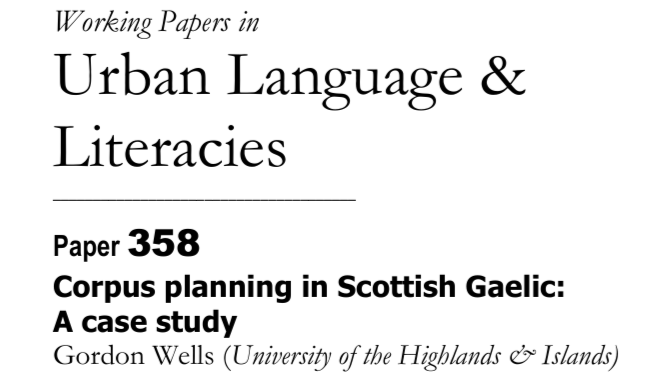
We’re delighted that the series editors took readily and quickly to publishing Gordon Wells’s paper as “Corpus planning in Scottish Gaelic: A case study”, the first contribution on Gaelic in this quickly growing and highly diverse collection with an extensive and worldwide online readership. (It’s also available through their Academia.edu page.) In the spirit of open collaboration they also encouraged us to share the paper on our own Research/Reports page, where readers will now find a new link. Taing mhòr, a chàirdean!
Here’s the abstract:
A detailed example is presented of an aspect of Scottish Gaelic corpus planning, focussing on the use of community-based authentic speech recordings to inform the production of guidance on a range of grammatical issues. Attention is drawn to a salient distinction between dialectal and idiolectal variation in relation to this task, and there is discussion of particular syntactic and semantic forms selected from the project’s stated terms of reference. Concluding remarks suggest and discuss issues for further research. Deeper linguistic analysis of the “phrasal verb” in use should throw light on some of the complexities of bilingual competences that may not currently be fully acknowledged in the Scottish Gaelic context. These complexities also have significance for the broader consideration of key practical planning processes entailing community participation and empowerment, as well as the construction of effective linguistic “authority”. These issues highlight the complex nature and significant scale of the challenges involved in effectively conducting this kind of work in a way that will gain real traction at community level in a context of ongoing language shift away from bilingualism towards increasingly monolingual use of English.