Island Voices Multilingual Archive
Introduction
The multilingual Island Voices/Guthan nan Eilean community project captures and curates “Slices of Life in and beyond the 21st Century Hebrides” in Gaelic, English and many other heritage languages. Leading up to its 21st anniversary, the University of the Highlands and Islands (UHI) secured this digital heritage of 500+ videos, co-created with the active participation of community members and groups within the Western Isles, across Scotland, and internationally, using state of the art archiving technology. This collected linguistic heritage is thus safeguarded against digital loss or damage, and made freely available for access by the general public.
The Island Voices project offers a model of community-based action in the maintenance of linguistic diversity and heritage in a world in which minoritised languages are under unprecedented threat. The archive stands out through its platforming of the voices of the people in the sharing of their unique cultural heritage.
This project has a special focus on saving heritage in both a general and particular sense. The global context is one in which language diversity is a universal intangible heritage openly acknowledged to be under greater threat now than at any previous point in recorded history. Languages such as Gaelic, and other community languages, uniquely encode and record the histories and knowledges of disparate peoples, both indigenous and migrant. Island Voices has been a pioneering place-based initiative which captures local Hebridean uniqueness, and models a dissemination mechanism in digital format for sharing with, and emulation by, other minoritised linguistic communities. With a focus on the primacy of speech, as demonstrated by ordinary community members, it contributes a vitally necessary linguistic foundation for efforts to maintain and/or revitalise a language ‘at risk’, with local people and community groups as the driving force. Island Voices thus acts as a model for saving linguistic heritage that has implications for, and influence over, the protection of language diversity way beyond its own Hebridean shores.
This project would not have been possible without the generous assistance of The National Lottery Heritage Fund. The items contained in the archive are all licenced under Creative Commons conditions, with stricter protections for recordings of oral history. (See The UHI Archive - Island Voices collection.)
The Community Project
The Community Project
The Hebrides-based “Guthan nan Eilean” (Island Voices) online language capture and curation project was born in 2005 out of the European project “POOLS” (Pooling Open Online Learning Systems). Multilingual partners across the continent teamed up to develop user-friendly technical aids for lesser-used languages, and POOLS was duly completed in 2007. 21 years later, Island Voices lives on still, having massively grown and diversified along the way while maintaining its linkage to UHI, now through the Language Sciences Institute CIALL project. (A detailed 2005-2023 history is available online.)
The Gaelic content spreads across a range of genres, domains and linguistic registers – with a principled focus on the spoken vernacular – including the unscripted real-life speech of ordinary community members, as well as documentary narrative and contemporary poetry from well-known writers and performers, such as Donald S Murray, Martin MacIntyre, and the late great Norman Maclean. The content reflects contemporary life through the unfiltered voices of real community members. Bespoke assistive technologies provide access for learners and non-speakers.
The societal challenges that Gaelic now faces are not unique to it, and its problems cannot be solved by looking only inwards. Island Voices has always balanced its Hebridean focus with an openness to cross-linguistic collaboration. Alongside Scots and Shaetlan examples, Irish and Welsh are important Celtic comparators. South Asian and Caribbean collaborations have also thrown light on potential connections that are still under-explored with other minority diaspora communities in Scotland and across the UK, while the English component is multi-functional.
The Extensions initiative shows how the Island Voices model is being progressively adopted and adapted for other languages. Ifor ap Glyn, National Poet for Wales 2016-22, is among the latest to make a significant contribution in this format.
Overall, Island Voices remains at heart a community-based project, and will continue in that role indefinitely, even after the archiving of its first 21 years of output at the University of the Highlands and Islands. Even so, a grounding linkage to academic research has been a key complementary focus throughout its existence, as recorded, for example, in Research/Reports. This UHI archive is one more example of the project’s key bridging function between community and academy.
The hyperlinks in the above text are mainly to archived copies of Island Voices materials. The original Wordpress.com and YouTube.com platforms for the ongoing project are here:
https://guthan.wordpress.com/about/
https://www.youtube.com/@IslandVoicesVideos
The UHI Archive Island Voices collection
The UHI Archive Island Voices collection
This collection consists of five parts:
- Mirror digital copies of the 500+ videos created by Island Voices and platformed on YouTube.com. These are securely stored in our safeguarding and digital preservation area and made freely available for public, student, and staff access. The video collection is divided up into eleven “series” and can be accessed directly through the UHI Archive catalogue.
- The entire Island Voices Wordpress.com website as it stood on 1st September 2026 has been captured and reproduced on the UHI Archive site. The Island Voices website consists of 500+ blogposts and pages, and traces the history of the project from the very start of its online presence.
The blogposts illustrate its development path and offer important contextual detail on the video contents.
The pages gather groups of videos together under a range of themes to help navigate the entire collection.
This UHI Archive Island Voices website collection has been amended and archivist's notes added where required to account for digital loss and deprecation over time. Additional links have been added to the tables of YouTube video contents, providing equivalent links to the corresponding copies in the UHI Archive. - Collection of additional audio materials referenced in the original WordPress site.
- Clilstore transcripts for the videos
- Published papers referenced in the collection
The archive contains material under two categories of Creative Commons licence:
- Generally available content:
Creative Commons Attribution-ShareAlike 4.0 International License, see https://creativecommons.org/licenses/by-sa/4.0/
This is attributed as “Island Voices Multilingual Archive, supported by The National Lottery Heritage Fund, licensed under CC BY-SA”
- Oral history content:
Creative Commons Attribution-NonCommercial-No Derivatives 4.0 International (CC BY-NC-ND) Licence, see https://creativecommons.org/licenses/by-nc-nd/4.0/
This is attributed as: “Island Voices Multilingual Archive, supported by The National Lottery Heritage Fund, licensed under CC BY-NC-ND”
About the heritage
About the heritage
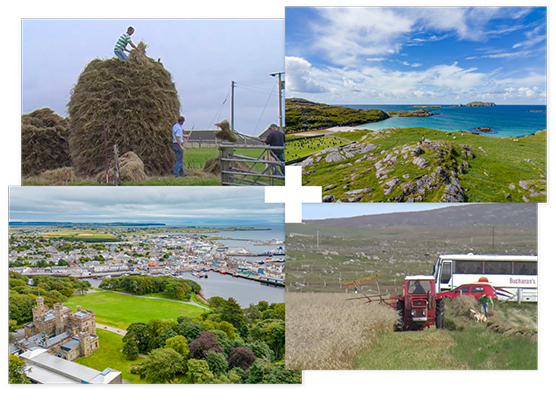
The remaining Gaelic communities of the Western Isles are the last inheritors of an unbroken culture and oral tradition that forms an intricate and integral part of Scottish history and identity, stretches back well over a thousand years, and manages to live on still, despite its now severely minoritised position. Set against this historical backdrop these Hebridean communities also offer a casebook study of modern-day cultural dynamics in which bi- and multi-lingual contacts and contexts present often stark challenges and choices. This societal environment of steadily continuing encroachment upon traditional and conventional domains for the use of Gaelic, in everyday life as much as in formal or informal cultural pursuits such as the composition or performance of poetry and music, is replicated in similar form in many other minority linguistic cultures, whether indigenous or migrant diasporic, both elsewhere in Scotland and the UK, as well as globally.
Humanity has a widely diverse linguistic heritage, evolved to respond to the grounded particularities of different times and places across the world. The Gaelic language encodes a unique worldview as it is experienced by its speakers in their homes and community locales. The Scottish Languages Act gives official recognition to the importance of the language within Scotland, and puts some legal measures in place to support its continuing use, both on a nationwide basis and in relation to special “areas of linguistic significance”.
To some extent, this official response relates to corresponding situations with other languages in similar situations, for example Irish or Welsh. In search of solutions to the problems facing a particular language community, there is room for well-informed exploration of other similarly challenged cultural heritages through coming together in joint enterprises, while retaining a grounded sense of local realities. Over the last twenty years the Island Voices project, based in the Outer Hebrides, has been capturing and curating the natural speech of Gaelic speakers as they voice in their own words their memories, thoughts, and reflections. This chimes perfectly with the UHI Language Sciences Institute’s focus on generating collective outcomes to support positive strategic and policy innovation to address societal challenges faced by minority languages.
The approach taken has been readily transferrable to enable comparison with, and adoption by, other similarly minoritised linguistic communities. This has resulted in a Gaelic-weighted yet profusely multilingual collection of 500+ video recordings featuring the authentic speech of community members as they relate unscripted stories and memories, descriptions and explanations, complemented by song performance and poetry recitations, and introduced by short plain language narrative documentaries. This is the heritage, highly valued by fluent community members, academic researchers, and language learners alike, that this archive seeks to safeguard.
About the risk
About the risk
In an era in which the loss of languages, particularly minoritised languages frequently termed “heritage languages”, is proceeding across the globe at an alarmingly accelerated rate, the risk to Gaelic (and other languages within the UK polity) is now well documented, for example through the comprehensive “Gaelic Crisis in the Vernacular Community” book jointly authored by LSI staff with other sociolinguistic researchers. Gaelic has been shown to face the imminent prospect of ceasing to operate as a language of daily use and conversational exchange in a community setting.
The last generation of fluent speakers with lived experience of growing up in a Gaelic-dominant environment, and hence acquiring the language through a normal process of inter-generational transmission at home and in the community, is of advancing age. They have important stories to tell from their own early life experiences, as well as their own reflections on witnessing the dramatic changes in community life as this transformative language shift has occurred before their eyes.
Island Voices has been a local presence for the past two decades in capturing and curating these narratives through the voices of ordinary community members. These are voices which may often struggle to be heard or noticed in national or institutional policy and decision-making fora, yet on which any language maintenance or planning initiative is crucially dependent, as they embody the linguistic competence which such bodies may seek to protect or promote.
Over the past twenty years, Island Voices has relied on technical and funding support from a wide range of disparate bodies in order to create and sustain its grassroots level approach to capitalising on powerful new digital affordances that help mitigate against documented linguistic risk. With the professional retirement of the project co-ordinator, there has been a requirement to gather the disparate outputs co-created with multiple stakeholders into a secure central storage point with guaranteed long-term longevity, to safeguard the digital artefacts themselves in a duplicated store, and ensure ongoing free public access to the first 21 years of the collection.
In working with the UHI Archive to capture and deposit the Island Voices project, the Language Sciences Institute has ensured this resource and its metadata are appropriately captured, catalogued, safeguarded, digitally preserved to prevent decay, and promoted with stakeholder communities and the public in order to provide permanent access to the collection for future use and research.
About the collector
About the collector
Gordon Wells is the son of Anna Sheonaidh ’ic Ghilleasbaig (née Ann MacLellan) from the Paible district of North Uist. He is a trained language teacher, and has degrees in Linguistics and Applied Linguistics from the Universities of York and Edinburgh respectively. He has lifelong experience of undertaking community-based language work enhanced by supporting media, starting with writing, recording and consultancy for BBC TV on its 1990s Hindi Urdu Bol Chaal series during his time with Birmingham Industrial Language Training Services. He has acquired fluent Gaelic oracy and literacy, alongside a richly informed sociolinguistic understanding of the societal context in which the language operates, coupled with familiarity with other similar situations of language contact and contestation, and tried and tested digital curation skills.
He created the original outputs in the Island Voices/Guthan nan Eilean collection over a period of 20+ years through active collaboration with a wide range of individuals, community groups, and educational institutions, some of which are active autonomous partners within the UHI network, and others not. Gordon’s association with the UHI project has been through various employers: Western Isles Enterprise and then UHI partner Lews Castle College (as was) from 1996 until 2004; from then till 2023 with a different UHI partner, Skye-based Sabhal Mòr Ostaig; from 2023 he worked directly with the Language Sciences Institute in UHI Executive Office.
The localised Island Voices project was born at Gordon’s own initiative out of the 2005-2007 "POOLS" European project (funded by Leonardo) in which Sabhal Mòr Ostaig was the contracting partner while featuring Uist-based community members and musical output from the Benbecula campus of Lews Castle College. Island Voices (Series 2) was then supported by the European Social Fund through Sabhal Mor Ostaig until 2010. After 2010, in his Projects Officer role with Sabhal Mòr Ostaig, additional work to continue building the collection was supported by a succession of follow-on European projects. By 2015 Island Voices was a well-established community presence through its YouTube channel in particular. It therefore made sense in community engagement terms to continue to use the channel to disseminate further video work that came under the wider UHI banner alongside unpaid voluntary contributions from community members and groups (eg local history societies). Following the 2023 establishment of CIALL at the Language Sciences Institute, a similar pattern continued up until his retirement in the autumn of 2026.
Project funding
Project funding
The University of the Highlands and Islands (UHI) was awarded £42,527 from The National Lottery Heritage Fund to safeguard and share this unique multilingual record of island life and connections. UHI has contributed £29,955 to the project, bringing the total investment to £72,482.
About UHI
UHI is an integrated university combining further and higher education – the only institution of its kind in Scotland, and one of few in Europe. We are more than a college and more than a traditional university: a diverse, flexible partnership, rooted in our communities and driven by their needs. Our network of colleges, specialist teaching centres and internationally recognised research institutes delivers supported, flexible learning from access level to PhD. With 48 locations across the Highlands and Islands, Moray and Perthshire, we offer education that’s local in focus and global in reach. Students are at the heart of everything we do. Their success is our measure. Through world-class teaching, research and knowledge exchange, UHI connects our regions to the world – and brings the world to our regions.
About The National Lottery Heritage Fund
Our vision is for heritage to be valued, cared for and sustained for everyone, now and in the future. That’s why as the largest funder for the UK’s heritage we are dedicated to supporting projects that connect people and communities to heritage, as set out in our strategic plan, Heritage 2033. Heritage can be anything from the past that people value and want to pass on to future generations. We believe in the power of heritage to ignite the imagination, offer joy and inspiration, and to build pride in place and connection to the past. Over the next 10 years, we aim to invest £3.6billion raised for good causes by National Lottery players to make a decisive difference for people, places and communities.